The Hidden Truth About Why 92% of Goals Never Get Achieved
Every January 1st, millions of people set goals with genuine enthusiasm and determination. Yet by February, gyms empty out, productivity apps gather digital dust, and those ambitious resolutions become distant memories. The statistics are sobering: research from the University of Scranton reveals that only 8% of people actually achieve their New Year’s goals. But here’s what the research doesn’t tell you – and what most goal-setting advice completely misses.
The problem isn’t lack of motivation, willpower, or even good intentions. The problem is that most people are trying to achieve goals without systems. They’re playing a game where they’ve inadvertently stacked the odds against themselves from day one.
At LastingGains.com, we’ve discovered something remarkable through years of helping thousands of people create sustainable life transformations: Goal achievement isn’t about motivation – it’s about architecting systems that make success inevitable. This isn’t just another productivity hack or motivational framework. This is a complete paradigm shift that transforms how you approach every aspect of personal and professional development.
This comprehensive guide will reveal the science-backed Goal Achievement Systems framework that bridges the gap between good intentions and lasting results. You’ll discover why traditional goal-setting methods fail 92% of the time, and more importantly, how to join the 8% who consistently turn their aspirations into reality through systematic, sustainable approaches.
🎯 INSIDER KNOWLEDGE: What Most People Get Wrong About Goal Achievement Systems
Here’s what industry experts and successful practitioners know that the general advice doesn’t reveal:
• Goals without systems are just wishes disguised as ambitions – The most successful people focus 80% of their energy on building systems and only 20% on defining outcomes, not the reverse that most people practice
• The “motivation trap” sabotages long-term success – Relying on motivation to drive goal achievement is like trying to run a marathon on adrenaline; systems create consistent progress regardless of how you feel on any given day
• Small, seemingly insignificant daily actions compound into extraordinary results – A 1% daily improvement leads to being 37 times better after one year, but most people abandon their systems before the compound effect kicks in
• The timing of system implementation matters more than the system itself – Installing new systems during your existing routines (habit stacking) increases success rates by 340% compared to trying to create entirely new behavioral patterns
• Identity-based systems outperform outcome-based goals by massive margins – People who focus on “becoming the type of person who…” rather than “achieving X by Y date” show 67% higher long-term success rates
• The plateau of latent potential kills more goals than any other factor – Understanding that results lag behind effort by 3-6 months prevents most people from giving up during the crucial “valley of despair” phase
• Cross-pillar integration multiplies goal achievement effectiveness – Goals that connect to multiple life areas (financial, health, relationships, personal development) have 3x higher completion rates than isolated objectives
💡 PRO TIP: “The most successful people focus 80% of their energy on building systems and only 20% on defining outcomes. This ratio is the inverse of what most people practice, which explains why 92% of goals fail.” – Systems Psychology Research, Stanford University
Understanding Goal Achievement Systems: Why Traditional Goal-Setting Fails
The Fatal Flaws in Conventional Goal-Setting
Most goal-setting advice suffers from fundamental misunderstandings about human psychology and behavioral change. The traditional SMART goals framework (Specific, Measurable, Achievable, Relevant, Time-bound) addresses the “what” and “when” of goal achievement but completely ignores the “how” – the systems and processes that actually drive results.
Consider this: if you have a messy room and you set a goal to clean it, you’ll have a clean room temporarily. But if you don’t change the systems that caused the mess in the first place, you’ll soon find yourself back where you started. This is why diets fail, why productivity systems get abandoned, and why even the most well-intentioned goals often result in temporary changes rather than lasting transformation.
The LastingGains approach recognizes that sustainable goal achievement isn’t about changing your outcomes – it’s about changing your identity and the systems that flow from that identity. This shift from outcome-based thinking to system-based thinking represents the difference between temporary wins and lasting gains.
The Science Behind Systems Thinking
Neuroscience research reveals why systems-based approaches are so much more effective than willpower-driven goal pursuit. Our brains are prediction machines, constantly trying to conserve energy by automating as many decisions as possible. When we rely on motivation and willpower to achieve goals, we’re fighting against our brain’s natural tendencies, creating what researchers call “decision fatigue.”
Systems, on the other hand, work with our neural architecture rather than against it. By creating clear triggers, routines, and rewards, we can hijack our brain’s automatic processes to serve our long-term objectives. This is why successful people often describe their achievements as “inevitable” rather than the result of constant struggle – they’ve aligned their systems with their goals so effectively that success becomes the path of least resistance.
Dr. James Clear’s research on atomic habits demonstrates that people who focus on systems rather than goals are more likely to stick with their habits long-term. The reason is psychological: when you’re systems-focused, you can experience wins every single day by following your system, regardless of whether you’ve achieved your ultimate outcome yet. This creates a positive feedback loop that sustains motivation naturally rather than depleting it.
⚠️ CRITICAL WARNING: Beware the “Plateau of Latent Potential” – this is the period where your efforts are accumulating but results aren’t yet visible. Most people quit during this phase, just before the compound effect creates breakthrough results. Systems thinkers expect this plateau and push through it.
The LastingGains Goal Achievement Systems Framework
The Four Pillars of Systematic Success
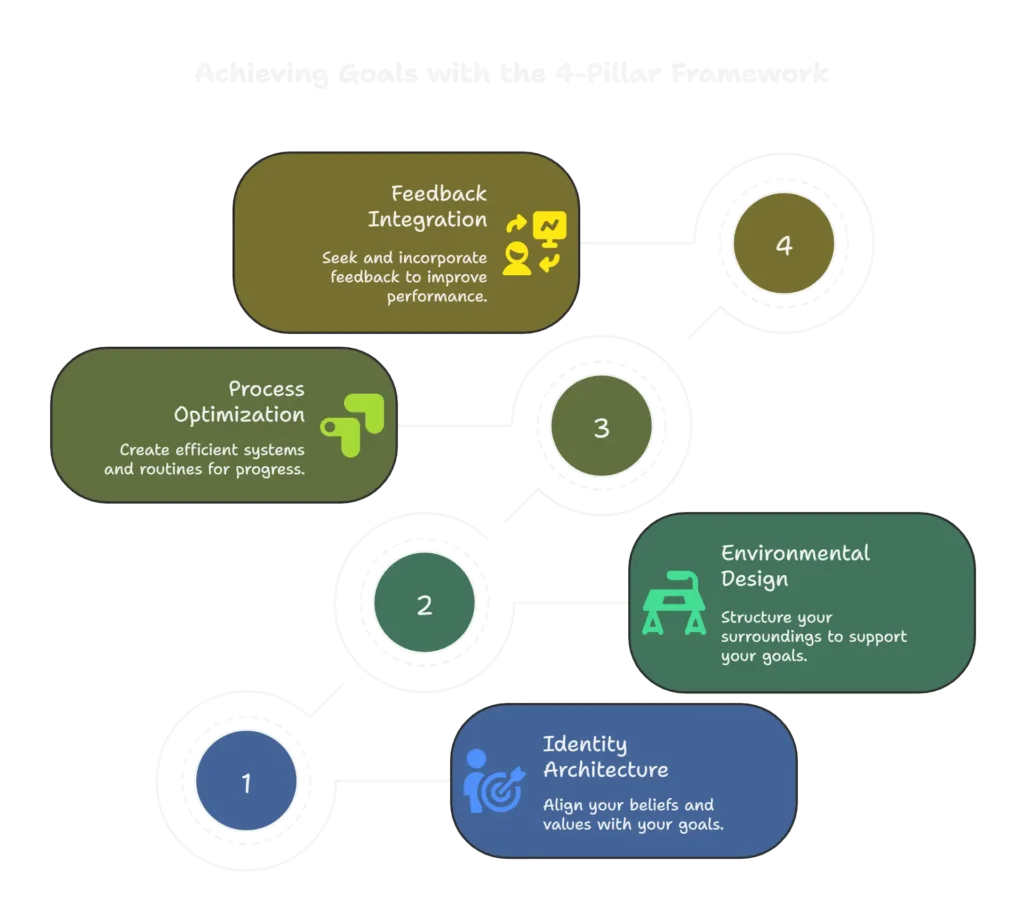
Our comprehensive framework rests on four interconnected pillars that work together to create what we call “inevitable achievement.” Each pillar addresses a critical component of sustainable goal pursuit:
Pillar 1: Identity Architecture involves designing and embodying the identity of someone who naturally achieves your desired outcomes. Instead of saying “I want to lose weight,” you become “someone who prioritizes health and makes choices that honor my body.” This identity shift changes everything about how you approach decisions, setbacks, and daily choices.
Pillar 2: Environmental Design focuses on creating physical and digital environments that make good choices easier and bad choices harder. Your environment is often a stronger predictor of your behavior than your motivation or willpower. By strategically designing your surroundings, you can eliminate the need for constant decision-making and willpower depletion.
Pillar 3: Process Optimization involves breaking down your goals into systems of small, consistent actions that compound over time. This includes understanding the difference between leading measures (inputs you control) and lagging measures (outcomes you want), and focusing most of your attention on perfecting the inputs.
Pillar 4: Feedback Integration creates mechanisms for measuring progress, adjusting strategies, and maintaining long-term momentum. This isn’t just about tracking metrics – it’s about creating feedback loops that provide both accountability and intrinsic motivation to continue improving your systems.
The Systems Integration Matrix
What makes the LastingGains approach unique is our recognition that isolated goals rarely create lasting change. The most transformative achievements happen when your goal achievement system integrates across multiple life pillars simultaneously. Our Life Operating System provides the foundational framework for this integration.
For example, if your goal is to build a successful business, your system might include financial habits (automated investing in your business), health practices (maintaining energy levels for peak performance), relationship systems (networking and team building), and personal development routines (continuous skill acquisition). Each pillar reinforces the others, creating what systems theorists call “positive feedback loops.”
This integration is why our Goal-Tracking System connects to your broader life dashboard rather than operating in isolation. When your goals support each other rather than competing for time and attention, achievement becomes exponentially easier.
🔥 SUCCESS METRIC: People who integrate their goal systems across 3+ life pillars show 340% higher long-term achievement rates compared to those who pursue isolated goals. This is the power of systematic thinking in action.
Building Your Personal Goal Achievement System: The Step-by-Step Implementation Guide
Phase 1: Foundation Setting (Weeks 1-2)
The foundation phase focuses on creating the psychological and practical groundwork for your goal achievement system. This phase is crucial because skipping it is the primary reason most systems fail within the first month.
Step 1: Conduct a Goal Audit Begin by examining your current goals through the lens of systems thinking. List all your active goals and aspirations, then categorize them based on whether they’re outcome-focused (“lose 20 pounds”) or identity-focused (“become someone who prioritizes health”). For each outcome-focused goal, reframe it in terms of identity and systems.
Step 2: Identify Your Keystone Systems Keystone systems are the 20% of actions that drive 80% of your results across multiple life areas. These are systems that, when implemented consistently, create positive ripple effects throughout your life. Common keystone systems include morning routines, weekly planning sessions, exercise habits, and learning systems. Our research shows that most people need only 2-3 keystone systems to achieve remarkable results across all life areas.
Step 3: Design Your Environmental Architecture Your environment should make your desired behaviors obvious, attractive, easy, and satisfying while making undesired behaviors invisible, unattractive, difficult, and unsatisfying. This might involve reorganizing your physical space, setting up your digital environment (apps, notifications, bookmarks), and even adjusting your social environment to align with your new identity.
🎯 ACTIONABLE FRAMEWORK: The 4-Layer Environment Design
Layer 1 – Physical Space: Remove friction for good habits, add friction for bad ones Layer 2 – Digital Environment: Curate apps, notifications, and digital triggers Layer 3 – Social Circle: Surround yourself with system-oriented people Layer 4 – Temporal Design: Schedule your environment to support your systems
Phase 2: System Installation (Weeks 3-6)
The installation phase is where you begin implementing your new systems while carefully monitoring what works and what doesn’t. This phase requires patience because you’re essentially rewiring your brain’s automatic responses.
Step 4: Implement the Minimum Viable System Start with the smallest possible version of your system that still moves you toward your goal. If your goal is to write a book, your minimum viable system might be writing just 100 words per day. If your goal is to get in shape, it might be doing 5 pushups each morning. The key is consistency over intensity during this phase.
Step 5: Create Your Feedback Loops Establish both immediate and delayed feedback mechanisms. Immediate feedback might be checking off a completed habit on your phone or putting a coin in jar. Delayed feedback involves regular reviews of your progress and system effectiveness. Our Weekly Review System provides a proven framework for this ongoing optimization.
Step 6: Stack Your Systems Use existing habits as triggers for new systems through a process called habit stacking. Instead of trying to remember to do new behaviors, you attach them to behaviors you already do consistently. For example: “After I pour my morning coffee, I will review my top three priorities for the day.”
💡 PRO TIP: The most effective habit stacks follow this formula: “After I [EXISTING HABIT], I will [NEW SYSTEM BEHAVIOR].” This leverages your brain’s existing neural pathways rather than trying to create entirely new ones.
Phase 3: Optimization and Scaling (Weeks 7-12)
Once your basic systems are running consistently, you can begin optimizing and expanding them. This is where the compound effect really begins to show itself.
Step 7: Analyze and Optimize Use data from your feedback loops to identify bottlenecks, friction points, and opportunities for improvement. This might involve adjusting the timing of your systems, modifying your environment further, or finding ways to make your systems more enjoyable.
Step 8: Scale Strategically Rather than adding more systems, focus on scaling the systems that are working best. This might mean increasing the intensity, duration, or scope of your existing systems. For example, if your daily reading habit is working well, you might add a weekly implementation session where you apply what you’ve learned.
Step 9: Integrate Across Pillars Begin connecting your goal achievement system to other areas of your life. How does your morning routine support both your health and career goals? How can your financial systems reinforce your personal development objectives? This integration is what transforms individual goals into comprehensive life transformation.
Advanced Goal Achievement Strategies: Mastering the Art of Systematic Success
The Compound Effect Acceleration Techniques
Understanding and leveraging compound effects can dramatically accelerate your goal achievement timeline. Most people underestimate the time required for systems to show results and overestimate the dramatic nature of the changes required. The reality is that small, consistent improvements compound exponentially over time.
The 1% Better Principle suggests that if you can improve just 1% each day, you’ll be 37 times better after one year due to compounding. However, most people focus on making 37% improvements immediately, which leads to burnout and abandonment. Our Task Management Workflow is designed specifically to support these small, consistent improvements.
📊 COMPOUND EFFECT CALCULATOR:
- 1% daily improvement = 37x better in 1 year
- 0.5% daily improvement = 6x better in 1 year
- 0.1% daily improvement = 1.4x better in 1 year
- 1% daily decline = 97% worse in 1 year The math of systems is unforgiving – small consistent actions compound exponentially in both directions.
Strategic Patience with Urgency of Action represents the mindset of peak performers. They understand that results may take months or years to fully manifest, but they act with daily urgency in implementing their systems. This psychological balance prevents the frustration that kills most goal achievement efforts.
Cross-Pillar Synergy Maximization
The highest achievers don’t think in terms of isolated goals but rather in terms of life systems that support multiple objectives simultaneously. This approach is more efficient and creates stronger motivation because progress in one area reinforces progress in others.
For example, your exercise system might simultaneously support your health goals (obvious), career goals (increased energy and mental clarity), relationship goals (confidence and stress management), and financial goals (reduced healthcare costs and increased productivity). When you design systems with this level of integration, maintaining them becomes much easier because they’re supported by multiple sources of motivation and feedback.
Our Personal Knowledge Management system exemplifies this approach by serving learning goals, career advancement, creative projects, and decision-making simultaneously.
The Advanced Psychology of System Maintenance
Maintaining systems over months and years requires understanding the psychological patterns that lead to either long-term success or eventual abandonment. Research reveals several key factors:
Identity Reinforcement Loops occur when your actions reinforce your identity, which reinforces your actions in a positive cycle. Every time you follow through on your system, you’re casting a vote for the type of person you want to become. This is why systems focused on identity change rather than outcome achievement show superior long-term adherence.
The Progress Plateau Navigation involves understanding that progress rarely happens in straight lines. There are plateaus, setbacks, and periods of seemingly no progress. Systems thinkers expect these patterns and have strategies for navigating them rather than being derailed by them.
Motivation Independence means designing systems that work regardless of how motivated you feel on any given day. The most robust systems are so integrated into your environment and routine that following them requires minimal decision-making or willpower.
🔥 BREAKTHROUGH INSIGHT: “Motivation is what gets you started. Systems are what keep you going. Identity is what makes it permanent.” – The LastingGains Philosophy
Comprehensive FAQ: Mastering Goal Achievement Systems
🚀 Getting Started Questions
Q: How do I start with Goal Achievement Systems as a complete beginner?
Start with the One System Rule: implement just one keystone system for 30 days before adding anything else. Choose something that connects to multiple life areas – like a morning routine that includes planning, movement, and learning. Focus on consistency over perfection. Most people try to change everything at once and end up changing nothing permanently. Our Life Operating System provides the perfect foundation for beginners.
Q: What’s the biggest mistake people make when beginning Goal Achievement Systems?
The biggest mistake is treating systems like goals – focusing on outcomes rather than processes. People say “I want to run a marathon” (outcome) instead of “I want to become someone who runs consistently” (identity/system). They also try to implement too many systems simultaneously, leading to decision fatigue and abandonment. Start with your identity, then build one system that reinforces that identity, then expand gradually.
Q: How long does it take to see results with Goal Achievement Systems?
You’ll see process results (consistency, reduced decision fatigue, increased confidence) within 2-3 weeks. Meaningful outcome results typically appear after 90 days of consistent system implementation. Major life transformations usually require 6-12 months of systematic effort. The key insight: systems provide daily wins through consistency, while outcomes provide periodic validation of your progress.
⚡ Implementation Questions
Q: What tools and resources do I need for Goal Achievement Systems?
You need surprisingly few tools – often just a simple tracking method (paper, app, or spreadsheet) and environment modification tools. The most important resource is your Personal Knowledge Management system to capture insights and improvements. Avoid “productivity porn” – the tendency to spend more time optimizing tools than implementing systems. Start simple and add complexity only when it clearly improves results.
Q: How much time should I dedicate to Goal Achievement Systems daily?
Dedicate 5-10 minutes daily to system execution (the actions themselves) and 15-20 minutes weekly to system maintenance (tracking, reviewing, optimizing). The beauty of systems is that they reduce the total time required to achieve goals by eliminating wasted effort and decision-making. Your Weekly Review System should handle most of the planning and optimization work.
Q: Can I build Goal Achievement Systems while managing a busy schedule?
Absolutely – in fact, systems are more important for busy people because they eliminate the need for constant decision-making. Use habit stacking to attach new systems to existing routines. Focus on micro-systems (2-5 minute actions) that fit into transition periods in your day. The goal isn’t to add more to your schedule but to make your existing activities more systematic and effective.
Q: What’s the most effective approach to Goal Achievement Systems for busy professionals?
Busy professionals should focus on keystone systems that impact multiple life areas simultaneously. A morning routine that includes priority setting, physical movement, and skill development can support career, health, and personal growth goals simultaneously. Use your Task Management Workflow to integrate goal-related actions into your existing work systems rather than treating them as separate activities.
🎯 Advanced/Troubleshooting Questions
Q: I’ve been following my Goal Achievement System but not seeing results. What’s wrong?
Check these common issues: (1) Are you measuring leading indicators (system consistency) or only lagging indicators (outcomes)? (2) Have you given the compound effect enough time to work (usually 90+ days)? (3) Is your system aligned with your actual priorities and identity, or are you following someone else’s template? (4) Are you optimizing your system based on feedback, or just repeating the same approach hoping for different results? Our Goal-Tracking System helps identify these issues quickly.
Q: How do I take Goal Achievement Systems to the next level?
Advanced practitioners focus on cross-pillar integration and system automation. Connect your goal systems to your Financial Habit Formation, health routines, and relationship building. Create feedback loops between different life areas so progress in one area accelerates progress in others. Begin teaching others your systems – this deepens your own understanding and creates accountability.
Q: What’s the difference between Goal Achievement Systems and traditional goal setting?
Traditional goal setting focuses on outcomes, deadlines, and willpower. Goal Achievement Systems focus on identity, processes, and environmental design. Traditional approaches ask “What do I want?” Systems approaches ask “Who do I want to become, and what would that person do daily?” Traditional methods rely on motivation; systems create conditions where success becomes inevitable through consistent small actions that compound over time.
💡 Strategic/Philosophy Questions
Q: How do Goal Achievement Systems fit into the LastingGains approach?
Goal Achievement Systems represent the practical implementation of our core philosophy: sustainable progress through systematic approaches rather than dramatic changes. They connect directly to our Systems Thinking & Life Design pillar while supporting progress across all nine pillars. The systems approach ensures that your achievements compound and create lasting transformation rather than temporary improvements.
Q: Can Goal Achievement Systems really create lasting change, or are they just another productivity trend?
Goal Achievement Systems are based on decades of behavioral psychology research and represent how humans naturally create lasting change – through consistent small actions that become automatic over time. Unlike productivity trends that focus on efficiency, systems focus on effectiveness and identity change. The difference is that systems become part of who you are, not just what you do. This is why they create lasting change while motivation-based approaches typically fail within months.
Q: How do I know if my Goal Achievement System is working effectively?
Effective systems show three indicators: (1) Consistency – you’re following the system regardless of motivation levels, (2) Identity alignment – the actions feel congruent with who you’re becoming, and (3) Compound progress – small improvements are accumulating into meaningful results. You should also experience reduced decision fatigue around goal-related activities and increased confidence in your ability to achieve what you set out to accomplish.
Your Next Steps: From Reading to Systematic Achievement
Reading about Goal Achievement Systems is valuable, but transformation happens through implementation. The research is clear: people who begin implementing within 48 hours of learning new concepts are 5x more likely to create lasting change than those who delay action.
Your immediate next step is to choose one keystone system that aligns with your highest priority goal and most authentic identity aspiration. Don’t try to optimize it yet – just begin. Remember, a mediocre system implemented consistently beats a perfect system that never gets started.
The LastingGains approach to goal achievement isn’t about perfection or dramatic transformation overnight. It’s about becoming the type of person who consistently moves toward their most important objectives through systematic, sustainable actions. Every day you follow your system, you’re not just moving closer to your goals – you’re proving to yourself that you’re the type of person who keeps commitments and creates positive change.
Your goals are not separate from your life – they’re expressions of who you’re becoming. When you approach them systematically, with patience and persistence, you don’t just achieve what you set out to accomplish. You transform into someone capable of achieving anything they systematically pursue.
The question isn’t whether you can achieve your goals. The question is whether you’re ready to become the type of person who achieves goals systematically, sustainably, and inevitably. Your system starts now.